Balbriggan sits at roughly 6 metres above sea level, with the Bracken River cutting through the town centre before meeting the Irish Sea. That low elevation means groundwater is never far below the surface. When a developer proposed a two-level basement on Mill Street, the water table appeared at just 1.8 metres in our boreholes. The deep excavations design had to manage buoyancy forces from day one. With 22,000 people calling the coastal town home, demand for multi-storey residential blocks is climbing, and every new build requires a solid excavation support system. Our team brings Eurocode 7 design methods to Balbriggan's unique mix of glacial till and soft alluvial deposits, combining field data from test pits with advanced PLAXIS modelling to predict wall deflections before a single bucket hits the ground.
A dry excavation in Balbriggan till can look perfectly stable for weeks, then fail in minutes when the first heavy rain saturates the tension crack network.
Methodology applied in Balbriggan
Risks and considerations in Balbriggan
A 7-metre cut on Chapel Street was left unsupported for three days while the contractor waited for steel props. A tension crack opened overnight 1.2 metres behind the crest, and the till face began spalling by noon. We had to backfill the toe with crushed stone within hours to arrest the movement. Base heave in Balbriggan's soft estuarine silt zones poses a different threat, particularly when the excavation is wide and the underlying clay is normally consolidated. We model undrained shear strength loss under unloading using SHANSEP parameters, and when the factor of safety drops below 1.5 we specify jet grout struts below the final formation level. Coastal sites north of the harbour face an additional challenge: tidal lag in the upper sand lens causes fluctuating effective stress that can fatigue temporary berms over a two-week construction cycle.
Our services
Our deep excavation design package covers every phase from concept to construction completion, tailored to Balbriggan's ground conditions.
Shoring and retaining wall design
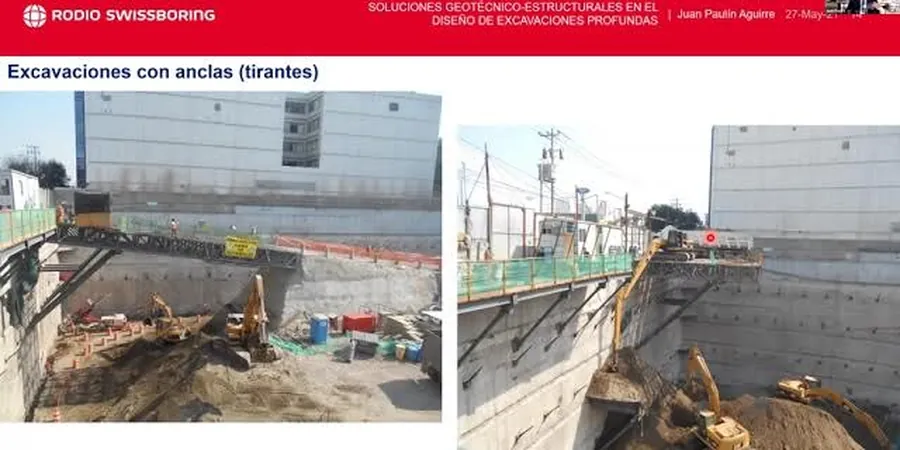
Full structural and geotechnical design of contiguous bored pile, secant pile, and sheet pile walls. We size walers, props, and corner braces to limit lateral displacement to 0.3% of excavation depth, verified with WALLAP and PLAXIS 2D/3D.
Dewatering and groundwater control plans
Hydrogeological assessment including pumping tests in the Balbriggan till aquifer. We design deep well arrays with real-time piezometric monitoring and prepare discharge consent documentation for Irish Water.
Construction-stage instrumentation and monitoring
Installation and interpretation of inclinometers, settlement markers, and vibration monitors. We set trigger levels at 70% of design limits and provide weekly reports with displacement versus time plots for the PSDP coordinator.
Frequently asked questions
What ground conditions should I expect for a deep excavation in Balbriggan town centre?
The typical sequence is 1–2 metres of made ground over medium dense sandy gravel, then stiff lodgement till extending to depths of 8–15 metres. The till contains sub-rounded cobbles and occasional boulders. Below the till you hit weathered shale bedrock. Groundwater usually sits within the gravel layer at 1.5–2.5 metres depth, though perched water can appear in sandy lenses within the till itself.
Do I need a party wall agreement for a basement excavation near neighbouring properties?
Yes. In Balbriggan, any excavation within 3 metres of an adjoining structure requires a party wall notice under Irish common law, and the PSDP process under the Safety, Health and Welfare at Work (Construction) Regulations demands a specific excavation risk assessment. We prepare the necessary geotechnical design statements and movement predictions to support both the party wall award and the construction stage safety file.
What does geotechnical design for a deep excavation cost in Balbriggan?
Fees for a full design package (ground investigation interpretation, wall and propping design, dewatering plan, and construction monitoring specification) range from €2,130 for a small single-level basement to €7,770 for a multi-level excavation with anchored walls and complex groundwater control. The scope of the site investigation and the number of design scenarios required will determine where your project falls within that range.