The coastal platform at Balbriggan sits on a complex transition between Cambrian quartzites of the Balbriggan Head and thick sequences of glacial till left by the Wicklow ice lobe. Groundwater emerges frequently along the contact between the bedrock and the overburden at depths of 2.5 to 4.8 m, which directly controls the drainage specification of any retaining wall design in the harbour fringe and along the Drogheda Road corridor. A retaining structure in Balbriggan must handle not only the lateral earth pressure of the lodgement till but also the perched water that builds up behind the wall after prolonged rainfall. The design sequence starts with a careful interpretation of the soil stratigraphy, because a wall founded in the wrong horizon can rotate within the first winter. Where the till contains silt lenses with artesian conditions, we often integrate the retaining wall design with an in-situ permeability programme to calibrate the weep-hole spacing and filter gradation before the structural model is finalised.
A retaining wall in Balbriggan fails most often from the back, not the front — poor drainage behind the stem creates hydrostatic pressures that no amount of steel can resist.
Methodology applied in Balbriggan
Risks and considerations in Balbriggan
The most frequent mistake we see in Balbriggan is treating the weathered till as if it were the same material as the intact till six metres down. The upper crust is fissured and oxidised to a brown silty clay; its undrained shear strength can be half of the parent material. A contractor who excavates to formation in summer, sees a hard dry bottom, and pours the wall base without a drainage blanket behind the stem will almost certainly see the wall lean forward by February. The mechanism is classic: winter rainfall saturates the fissures behind the wall, builds pore pressure, and the reduced effective stress pushes the thrust line outside the middle third of the base. Add a surcharge from a garden wall or a parked car on the high side and the factor of safety drops below 1.0. The remediation in such cases involves installing retrofitted sub-horizontal drains through the stem or constructing a counterfort berm at the toe — both far costlier than including a continuous gravel drain and a perforated collector pipe from day one.
Our services
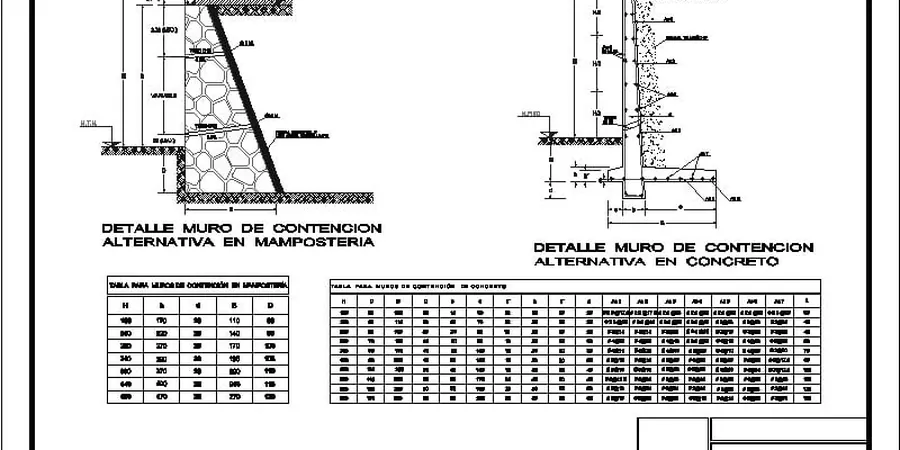
A retaining wall design in Balbriggan is never a standalone structural exercise — it sits at the intersection of ground investigation, groundwater modelling and construction sequencing. Our workflow integrates site-specific parameters from the earliest stage so that the wall section, drainage detail and reinforcement schedule are consistent with the soil that will actually be retained.
Geotechnical interpretative report for retaining structures
Compilation of borehole logs, laboratory strength tests and groundwater monitoring data, interpreted to derive the design soil parameters (phi-prime, c-prime, undrained shear strength, stiffness) for each stratum behind and below the proposed wall alignment.
Structural design and detailing of retaining walls
Limit state design to Eurocode 7 and Eurocode 2 covering overturning, sliding, bearing capacity and global stability. Includes crack-width verification for durability in coastal exposure, reinforcement schedules and construction sequence notes.
Drainage and filter design
Design of the wall drainage system — granular backfill gradation, geotextile filter selection, weep-hole spacing and collector pipe sizing — matched to the permeability and frost susceptibility of the local till.
Construction monitoring and hold-point inspections
On-site verification during excavation that the ground conditions match the design assumptions, including approval of the founding stratum before blinding concrete is poured and compaction testing of structural backfill.
Frequently asked questions
How much does a retaining wall design for a residential site in Balbriggan typically cost?
For a single residential retaining wall in the Balbriggan area, the geotechnical and structural design package generally ranges from €900 to €3,820, depending on the retained height, the complexity of the ground profile and whether groundwater control measures need to be designed. A small garden wall under 1.2 m height on competent till sits at the lower end; a wall over 2.5 m near the harbour, requiring sheet pile analysis and a full drainage specification, moves toward the upper end.
What is the maximum height you can design a cantilever retaining wall in the till soils around Balbriggan?
In the stiff lodgement till found across much of Balbriggan, a reinforced concrete cantilever stem can be designed for retained heights up to approximately 4.5 m, provided the embedment ratio is generous and the wall is backfilled with free-draining granular material. Beyond that height the bending moments at the base become uneconomical and we start considering counterfort walls, anchored systems or mechanically stabilised earth (MSE) alternatives.
Do retaining walls in Balbriggan need planning permission?
Planning requirements in Balbriggan fall under Fingal County Council. Generally, a retaining wall over 1 m in height that forms a boundary or supports a public road or footpath requires planning permission. Walls within a private garden that do not alter ground levels significantly may be exempt, but it is essential to check with the council because proximity to protected structures or the harbour conservation area can trigger additional requirements.
How do you account for the effect of the sea on retaining walls near Balbriggan Harbour?
The main marine influence near the harbour is not direct wave impact but airborne chloride exposure, which drives the concrete specification toward a higher cover to reinforcement and tighter crack-width limits under exposure class XS1. We also check for tidal fluctuation effects on the groundwater table behind the wall, because a rapid drawdown can generate transient pore pressures that temporarily increase the active thrust on the wall.