Balbriggan's coastal position on the Irish Sea means many sites sit on compressible estuarine silts or glacial till with lenses of soft clay—conditions where traditional footings become uneconomical fast. The town has grown steadily since the M1 motorway improved access, and with it has come demand for commercial builds and housing estates on marginal ground. We approach stone column design here with a clear understanding of how local drift geology varies within a few hundred metres: the superficial deposits mapped by Geological Survey Ireland show alluvium along the Bracken River corridor, while the headlands expose stiffer lodgement till. When you need to transfer structural loads through 4 to 8 metres of soft material without deep piling, a properly sized vibro-replacement grid—checked against the partial factors in I.S. EN 1997-1:2005—is often the most cost-effective path. For sites where the soft layer is deeper, we often combine the stone column layout with a CPT test to profile the transition to bearing stratum before finalising the grid spacing.
A stone column grid is only as reliable as the sensitivity ratio it was designed for—ignore the smear zone in Balbriggan’s silts and you’ll be re-levelling floor slabs within three winters.
Methodology applied in Balbriggan
Risks and considerations in Balbriggan
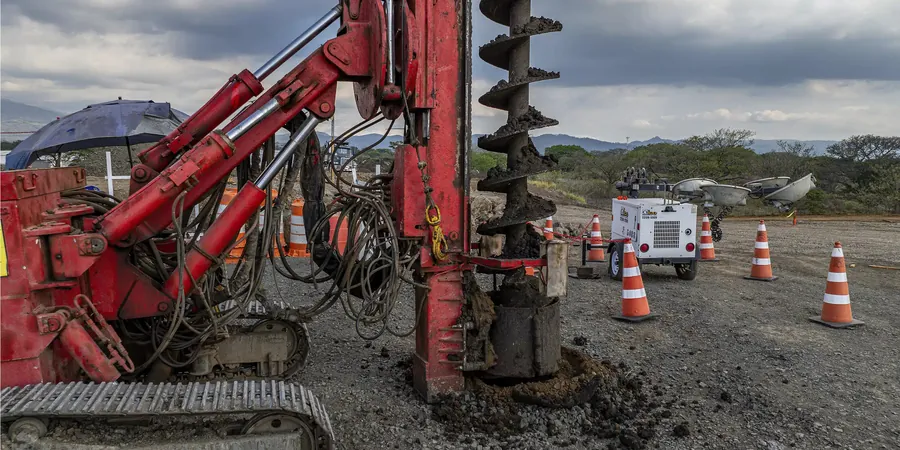
The story we encounter most often in Balbriggan goes like this: a contractor excavates for a light industrial unit on the outskirts, hits grey silty clay at 2 metres, and decides to over-excavate and replace with stone—only to find the water table is perched just below formation level and the ‘replacement’ turns into a pumping operation that costs twice the original earthworks budget. Stone column design addresses this scenario from the surface down, installing through the soft layer via vibroflot without dewatering, and creating a drained composite mass that speeds up consolidation. The risk that remains, and the one we focus our verification on, is differential settlement at the column-to-untreated-soil interface under cyclic loading—especially where Balbriggan’s seasonal groundwater fluctuates by over a metre between winter and late summer. By running a settlement analysis with the actual stiffness improvement ratio from a pre-production trial, we can keep angular distortion below 1/500, which is the threshold most structural engineers accept for masonry-clad frames.
Our services
Our stone column design package for Balbriggan projects covers the full sequence from concept to verification, and we adjust the scope depending on whether the primary objective is settlement reduction, bearing capacity increase, or liquefaction mitigation—all three drivers appear in the northeast Dublin region depending on site location relative to the coast.
Design Development & Unit-Cell Modelling
Full Priebe method or finite element unit-cell analysis calibrated to site-specific sensitivity and modulus degradation curves from laboratory triaxial testing.
Pre-Production Trial & Performance Verification
Installation of three to five trial columns with instrumentation to measure pore pressure dissipation, followed by zone load testing to confirm the composite deformation modulus before production.
Construction-Phase Monitoring & QA
Continuous recording of vibrator depth, amperage, and stone consumption per column, with daily reports benchmarked against the design grid to flag any deviation in real time.
Frequently asked questions
How much does stone column design and ground improvement typically cost for a Balbriggan site?
Our design and verification package for Balbriggan projects usually falls between €1,180 and €4,040, depending on the number of columns, the depth of the soft layer, and whether a pre-production trial with zone load testing is required by the client’s insurer or the building control authority.
What depth of soft ground can stone columns treat in this area?
In Balbriggan’s geology we typically design for treatment depths between 4 and 12 metres. Beyond about 15 metres, the vibrator energy attenuation becomes significant and we will usually compare the cost against driven piles or controlled modulus columns to confirm stone columns remain the economical choice.
How do you confirm the stone columns are working after installation?
We specify zone load tests on at least one working column per 200 installed, loading to 1.5 times the design working load and measuring settlement over a 60-minute hold period. This is supplemented by post-treatment CPT or SPT soundings through the column centre and mid-column spacing to verify the stiffness improvement ratio matches the design assumption.
Do stone columns reduce liquefaction risk in Balbriggan’s sandy layers?
Yes, and we design specifically for that where the site investigation reveals loose sand lenses below the water table. The vibroflot densifies the sand around each column, and the column itself acts as a vertical drain, reducing pore pressure build-up during shaking. We use the NCEER/Youd-Idriss procedure with post-treatment SPT blow counts to confirm the factor of safety against liquefaction exceeds 1.2.