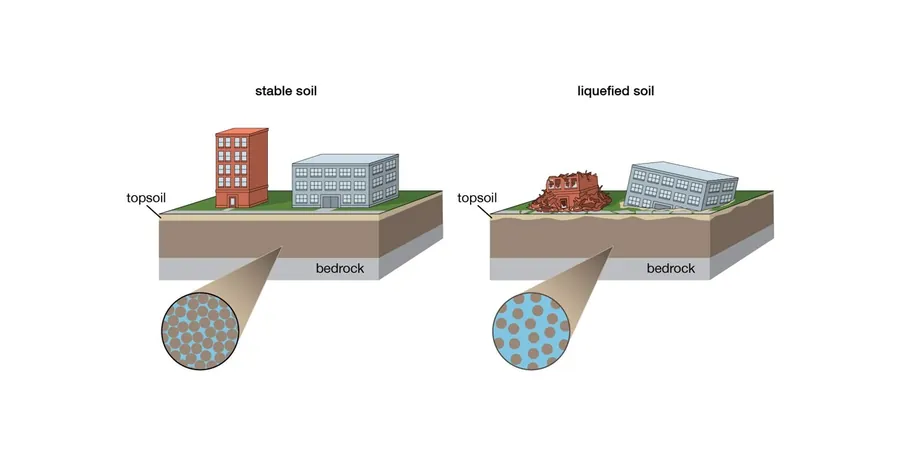
The most expensive mistake in Balbriggan foundation design is assuming dense sand won't liquefy. It can. Coastal towns like Balbriggan sit on sequences of apparently competent sands that are actually loose, saturated, and ready to lose all strength under cyclic loading. A standard site investigation misses this. You need a targeted liquefaction analysis. We run the numbers. We use seed data from SPT or CPT and apply the Youd & Idriss (2001) framework to calculate the factor of safety against liquefaction for every critical layer. The output isn't a generic report—it's a layer-by-layer risk map with settlement estimates and, where needed, ground improvement recommendations. For projects near the Balbriggan coast, where groundwater is high and the sand is geologically young, skipping this analysis is gambling with the foundation.
Liquefaction doesn't require a major earthquake—in loose, saturated sand, even a small tremor can erase bearing capacity in seconds.
Methodology applied in Balbriggan
Risks and considerations in Balbriggan
The risk isn't uniform across Balbriggan. The low-lying areas near the harbour and along the Bracken River floodplain are underlain by recent alluvial sands—loose, clean, and fully saturated. These areas have a high liquefaction potential index (LPI). In contrast, the slightly elevated ground to the west, closer to the M1, sits on stiffer glacial till that is not liquefiable. A site on the coastal side of the railway line will tell a very different story from one on the inland side. We have seen boreholes 500 meters apart show FSliq values of 0.6 versus 2.5, purely because of a change in depositional environment. This spatial variability is why we insist on multiple test points. A single SPT borehole can miss a loose lens. We pair your investigation with a site-specific seismic hazard assessment, factoring in the Irish National Annex to Eurocode 8, to ensure the ground acceleration used in the CSR calculation is realistic, not a generic code value.
Our services
Our liquefaction assessment in Balbriggan is not a standalone product—it integrates field data, lab testing, and analysis into a single, coherent deliverable. We provide:
SPT-Based Liquefaction Screening
We use your SPT N-values to calculate CRR and FSliq per the NCEER method. This is the most cost-effective screening tool for small to mid-size Balbriggan developments.
CPT-Based Detailed Profiling
For high-sensitivity sites, we use CPT data to generate a continuous profile of liquefaction susceptibility. The cone's soil behavior type index (Ic) identifies thin liquefiable layers that SPT misses.
Post-Liquefaction Settlement Analysis
We estimate ground surface settlement after liquefaction, using the Ishihara & Yoshimine (1992) chart method, to inform foundation performance requirements.
Ground Improvement Feasibility
Where liquefaction risk is unacceptable, we evaluate the technical viability of mitigation measures—from vibrocompaction to stone columns—and provide preliminary design parameters.
Frequently asked questions
What does a soil liquefaction analysis in Balbriggan cost?
For sites in Balbriggan, a desktop screening plus SPT-based liquefaction analysis typically falls between €2,080 and €3,700 depending on the number of boreholes and the complexity of the soil profile. A CPT-based analysis is at the upper end of that range. The final cost depends on how much existing site investigation data you can provide.
Is liquefaction really a risk in Ireland with such low seismicity?
Yes, in specific conditions. The seismic hazard in eastern Ireland is low, but not zero—the magnitude 5.4 Lleyn Peninsula earthquake in 1984 was felt in Dublin. The risk in Balbriggan is driven less by the earthquake magnitude and more by the presence of loose, saturated, sandy soils in the coastal zone. Even a local magnitude 4.0 event can induce pore pressure build-up in these deposits.
What field data do you need to run the analysis?
We need SPT N-values with depth, or CPT tip resistance and sleeve friction, from a borehole or cone penetration test that penetrates below the water table. We also require grain size distribution curves to assess the fines content, as this directly affects the CRR correction factor. If you only have borehole logs without SPT, we can still screen for liquefaction susceptibility using the soil description and depth to groundwater.
How do you calculate the ground settlement after liquefaction?
We use the Ishihara and Yoshimine (1992) method. The factor of safety against liquefaction for each layer is correlated to a maximum volumetric strain, which is then integrated over the liquefied thickness to give a total settlement. This value is critical for assessing whether a shallow foundation can tolerate the deformation, or if a deep foundation or ground treatment is required.
What happens if the analysis shows a high liquefaction risk?
The engineering response depends on the project. Options include deepening the foundation to bypass the liquefiable layer, using piles socketed into the underlying till, or treating the ground in situ. For Balbriggan sites, vibrocompaction and stone columns are technically viable in the clean sands near the coast. We provide the design parameters—post-treatment SPT target, grid spacing, and verification testing protocol—so you can specify the ground improvement works with confidence. More info.