A residential development off Hamlet Lane was moving into the earthworks phase when the contractor hit a snag: the fill material, a glacial till common across north County Dublin, was proving difficult to compact uniformly. Balbriggan sits on a complex mix of these tills and nearshore sands, a legacy of the last glaciation that shaped the coast between the River Delvin and the Irish Sea. The site engineer called us to run a series of Proctor compaction tests because the on-site nuclear gauge readings were inconsistent. Without a solid laboratory reference curve for that specific borrow source, no amount of rolling would guarantee the 95% relative compaction specified by the project’s geotechnical designer. We see this pattern repeat across Balbriggan, from the new housing estates near Bremore to commercial builds along Dublin Street, where imported fill or reworked natural ground needs a precise compaction target before earthworks quality control can begin. Pairing the Proctor with a sand cone density test in the field gives you a defensible, traceable record that the placed fill meets the specification.
A Proctor curve built from the wrong compactive effort is worse than no curve at all: it gives a false sense of security that the fill is compacted when it isn't.
Methodology applied in Balbriggan
Risks and considerations in Balbriggan
In Balbriggan, we often see site-won material with a higher silt content than the contractor expects, especially when digging below the weathered zone. This material is moisture-sensitive; a rain shower can push it above optimum moisture content by 2 or 3 percent in a matter of hours. If the earthworks crew continues compacting without adjusting the moisture, the fill will never reach the required density, no matter how many passes the roller makes. The Proctor test quantifies this relationship precisely, giving the maximum dry density and the corresponding optimum moisture content for that specific soil. Using a generic compaction curve from a different site is a gamble that leads to under-compacted lifts, future settlement under road pavements, and cracked floor slabs. For critical infrastructure like the Balbriggan wastewater treatment plant expansion or school extensions, the cost of repairing settlement damage far exceeds the cost of a properly conducted Proctor test program during construction.
Our services
Our compaction testing program in Balbriggan addresses the full cycle of earthworks verification, from laboratory reference testing to field density correlation. We work with local ground conditions typical of the Fingal area.
Standard & Modified Proctor Testing
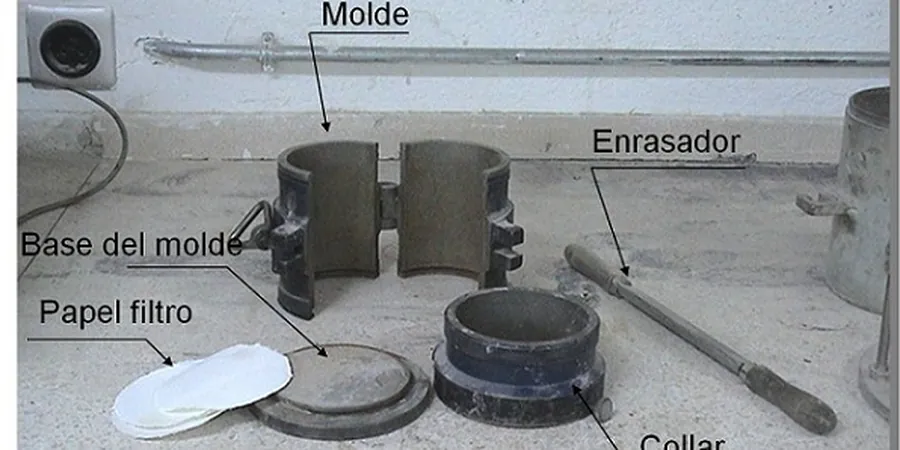
We run both the standard Proctor (2.5 kg rammer, 305 mm drop) and the modified Proctor (4.5 kg rammer, 457 mm drop) per BS 1377-4:1990. The standard test suits normal building pads and landscaping fills; the modified test applies to heavy-duty pavement subgrades and engineered fills under high structural loads, common in Balbriggan’s industrial park expansions.
Field Compaction Correlation
Laboratory Proctor curves mean little without field verification. We correlate the lab maximum dry density with in-place density measurements using the sand cone density method on active earthworks sites across Balbriggan, producing a relative compaction percentage that demonstrates specification compliance to the resident engineer.
Frequently asked questions
What’s the difference between Standard and Modified Proctor compaction testing?
The Modified Proctor uses a heavier rammer (4.5 kg vs 2.5 kg) and a greater drop height (457 mm vs 305 mm), delivering roughly 4.5 times more compactive energy to the soil. This simulates the effort of modern heavy vibratory rollers and loaded dump trucks. In Balbriggan, we specify Modified Proctor for road subgrades and heavily loaded industrial slabs; Standard Proctor is usually sufficient for residential house pads and landscape fills with lighter loading.
How much does a Proctor test cost in Balbriggan?
A standard Proctor compaction test (BS 1377-4, 2.5 kg rammer) in our Balbriggan laboratory typically ranges from €100 to €130, while the modified Proctor (4.5 kg rammer) runs between €140 and €170, depending on the number of points on the compaction curve and whether the material requires oversize correction for gravel content.
Why can’t I just use a nuclear density gauge without a lab Proctor curve?
A nuclear gauge gives you a wet density and moisture reading in the field, but it cannot tell you the maximum dry density achievable for that specific soil. The relative compaction percentage, which is what the specification requires, is the ratio of field dry density to the laboratory maximum dry density from the Proctor test. Without the lab curve, you’re measuring density without a target, which is meaningless for acceptance purposes.
How many Proctor tests do I need for a typical house site in Balbriggan?
At minimum, one Proctor test per distinct borrow source or per significant change in soil type. For a single-house plot on the outskirts of Balbriggan where all fill comes from one excavation, one standard Proctor test is often sufficient. For a multi-phase development with imported stone fill and site-won cohesive material, you’ll need a separate Proctor curve for each material. We recommend one field density check per lift per 250 m² of compacted area.