The glacial till that skirts the Balbriggan coastline and the alluvial silts near the Bracken River present two very different geotechnical challenges — one a stiff, over-consolidated lodgement till, the other a soft, often organic estuarine deposit. Contractors working between Flemington and the harbour know that a soil’s behaviour at different moisture contents can make or break a foundation design. Our laboratory team runs the Atterberg limits series on these materials weekly, quantifying the transition from brittle solid to plastic paste to viscous liquid. The data feeds directly into the Unified Soil Classification System, giving the design engineer a reproducible measure of the clay fraction’s activity. When fill materials are being imported for a laneway upgrade or a new build off the Naul Road, we often pair the limits with a grain size analysis to confirm the full particle-size distribution before compaction specification begins.
The liquidity index — not just the Atterberg numbers — tells you whether a Balbriggan clay will behave as a brittle solid or a viscous fluid under load.
Methodology applied in Balbriggan
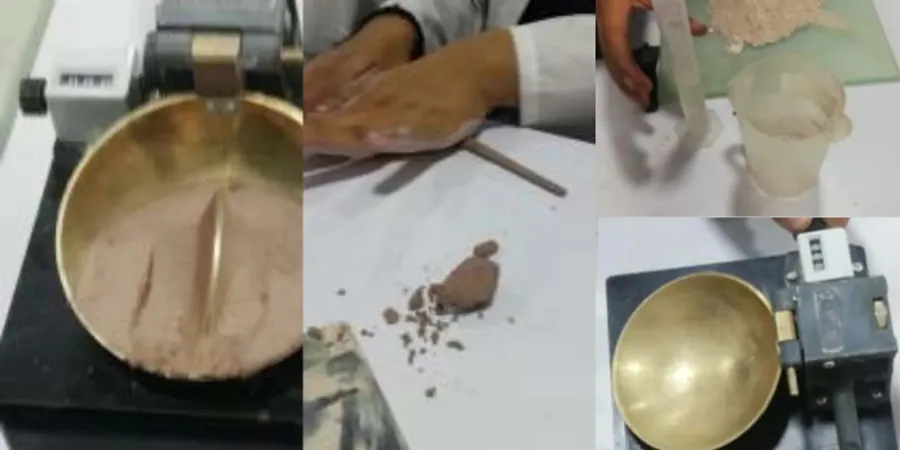
Risks and considerations in Balbriggan
Balbriggan’s expansion from a small fishing port into a commuter town has pushed development onto the glacial tills and riverine silts that were never thoroughly characterised during the original Victorian platting. The risk surfaces when a plasticity index above 20% meets the region’s wet winters — the Bracken River floodplain clays can swell enough to lift lightly loaded slabs and pavement subgrades. Even more insidious is the shrinkage side of the cycle: during the dry spells of late spring, the same soils crack and open preferential drainage paths that accelerate consolidation under foundations. Without Atterberg limits determined on undisturbed samples, the design team is guessing at the heave potential. A liquidity index close to 1.0 in a soft alluvial clay beneath a proposed retaining wall signals near-failure consistency — a condition that demands either excavation and replacement or a solid retaining wall drainage design to keep the moisture content stable over the structure’s life.
Our services
Our Balbriggan geotechnical laboratory provides the full Atterberg limits suite as both a standalone classification package and as part of integrated ground investigation programs. Turnaround is typically three working days for routine samples.
Three-Point Atterberg Classification
Liquid limit by 80 g / 30° fall cone, plastic limit by thread-rolling, and natural moisture content — the minimum set for USCS classification and liquidity index calculation. Suitable for single-house foundations, agricultural sheds, and road subgrade verification in the Balbriggan area.
Full Consistency Suite with Shrinkage Limit
Adds the shrinkage limit by mercury displacement or wax immersion, plus a linear shrinkage bar test. Used for embankment clay liners, landfill capping, and flood defence bunds where desiccation cracking is a design concern.
Moisture Conditioning and Activity Analysis
When the clay fraction is suspected to contain swelling smectites — occasionally found in weathered volcanic ash lenses within the till — we run parallel Atterberg limits on the whole sample and the clay-size fraction alone to derive the Skempton activity ratio.
Frequently asked questions
How much does Atterberg limits testing cost for a single sample from a Balbriggan site?
A single-sample three-point classification (liquid limit, plastic limit, natural moisture content) typically runs between €70 and €110, depending on whether the sample arrives already air-dried and sieved or requires full preparation in our lab. Shrinkage limit and activity analysis are quoted separately.
Which Atterberg test method does the Balbriggan lab use — Casagrande cup or fall cone?
We run the fall-cone penetrometer method as the primary liquid limit determination, in line with BS EN ISO 17892-12:2018. The Casagrande cup is available on request for legacy comparisons or North American reporting, but we find the cone gives more reproducible results across operators.
What sample size do you need for a complete Atterberg limits determination?
We require a minimum of 300 grams of material passing the 425 µm sieve. If the sample arrives as a bulk bag, we oven-dry and sieve it in-house; if it comes as a disturbed cutting from a trial pit or auger flight, just double-bag it to preserve the natural moisture content.
How long does it take to get Atterberg limits results back?
Standard turnaround is three working days from sample receipt for a routine classification set. Expedited 24-hour reporting can be arranged for urgent foundation decisions — call the lab before sending the sample so we can schedule the oven-drying and testing sequence.