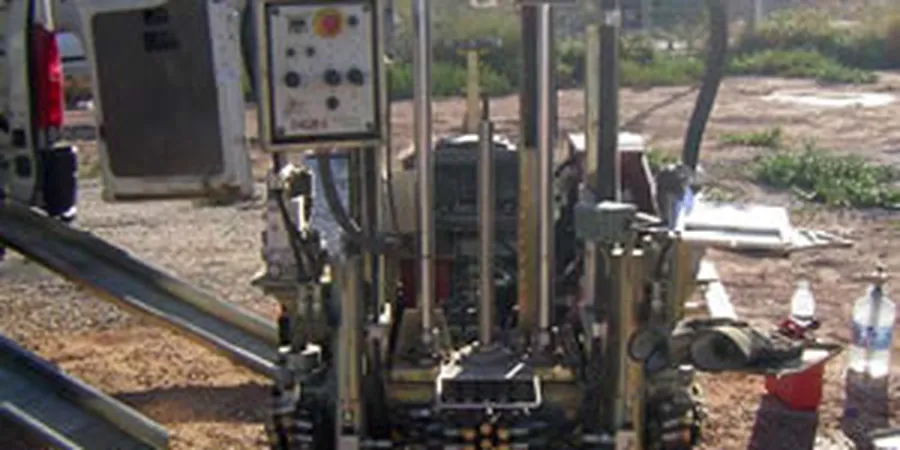
A 20-tonne CPT truck with a hydraulic ram presses a 60-degree conical tip through the ground at a constant 2 cm per second, recording tip resistance and sleeve friction every 10 millimetres. In Balbriggan, where subsurface conditions shift from dense lodgement till to soft post-glacial silts within a few hundred metres of the shoreline, this continuous profile reveals stratigraphy that a borehole log alone would miss. The SPT drilling crew often works alongside our CPT rig on sites near the Bracken River, where the contrast between stiff boulder clay and compressible alluvium demands two complementary datasets before a foundation design can proceed. The rig operator watches the real-time readout on a rugged screen inside the cab, calling out pore pressure dissipation rates to the engineer standing beside the truck. That immediate feedback loop means the data is already being interpreted before the cone reaches the target depth, usually 15 to 25 metres below ground level depending on the site’s proximity to the Irish Sea.
A CPT sounding in Balbriggan’s glacial till captures tip resistance, sleeve friction, and pore pressure in one push, reducing the uncertainty that drives up foundation costs.
Methodology applied in Balbriggan
Risks and considerations in Balbriggan
Balbriggan’s population has grown to over 22,000, and the Fingal Development Plan 2023–2029 is pushing residential density into areas underlain by the Rathmolyon Esker-derived sands and interbedded lacustrine clays. These deposits exhibit natural moisture contents close to the liquid limit, and a CPT sounding that shows low tip resistance combined with slowly dissipating excess pore pressure signals a genuine settlement risk for lightly loaded shallow foundations. The Irish National Annex to Eurocode 7 requires that the undrained shear strength profile used in bearing capacity calculations be derived from a minimum of three CPT soundings per building block when the coefficient of variation exceeds 30%, which happens frequently on the mixed glacial and post-glacial materials found between the M1 motorway and the coast. Ignoring that requirement and relying solely on a desk study or a single trial pit has led to differential settlement claims on more than one North County Dublin housing scheme in the past decade. The CPT data also feeds directly into liquefaction screening: with the Irish Sea less than 300 metres from some development parcels, the groundwater regime is tidally influenced, and the seismic demand from intraplate events in the Irish Sea basin, though modest, still warrants a check against Seed-Idriss simplified procedures when loose saturated sands are encountered.
Our services
The CPT service in Balbriggan covers the full data pipeline from field sounding to interpreted engineering parameters, calibrated for the glacial and post-glacial soils that dominate construction sites in the area.
Standard CPTu Sounding
Piezocone penetration with continuous measurement of tip resistance, sleeve friction, and pore pressure at the u₂ shoulder position. Delivers soil behaviour type classification, undrained shear strength, and relative density profiles for foundation design in the glacial till and alluvial deposits common across Balbriggan.
Pore Pressure Dissipation Testing
Stopped penetration at selected depths to record the decay of excess pore pressure over time. The t₅₀ consolidation parameter derived from these tests provides direct input for settlement rate calculations on the soft silty clays found near the Bracken River and the Balbriggan harbour area.
Interpretative Geotechnical Report
Full reduction of CPT data to engineering parameters including Su/σʹv₀ ratio, constrained modulus, and overconsolidation ratio. Correlated with local geological mapping from the Geological Survey of Ireland’s Quaternary mapping programme and presented with depth profiles suitable for direct use in Plaxis or Settle3 models.
Frequently asked questions
How much does a CPT test cost in Balbriggan?
A standard CPT sounding in Balbriggan typically runs between €150 and €250 per metre of penetration, with the final cost depending on access conditions, the number of dissipation tests required, and whether the rig needs tracking mats for soft ground near the coast. A full site investigation with four to six soundings and a reporting package will usually fall within a range that reflects the depth and complexity of the subsurface profile.
How deep can a CPT rig push in Balbriggan’s glacial till?
The depth achievable depends on the density of the till and the reaction mass of the CPT truck. In the lodgement till that underlies much of Balbriggan, refusal typically occurs between 18 and 28 metres when cone tip resistance exceeds 50 MPa and the friction sleeve load approaches the rig’s hydraulic capacity. On sites with a thick cover of soft alluvium, the rig can reach the till interface and penetrate a few metres into the stiff material before refusal.
What information does a CPT provide that a borehole does not?
A CPT delivers a continuous, high-resolution profile of soil behaviour type and strength with depth, rather than the discrete samples and blow counts from an SPT borehole. The piezocone also measures pore water pressure during penetration, which allows the engineer to identify drainage conditions and estimate consolidation characteristics directly. On Balbriggan sites with interbedded sands and clays, the CPT trace reveals thin layers that a standard sampler would miss entirely, and the dissipation tests provide in-situ permeability indicators that are critical for dewatering design.