A two-storey extension on Chapel Street hit refusal at less than a metre. Solid limestone bedrock, right where the architect had drawn a 1.2 m strip footing. That job taught us something we already knew but always bears repeating: in Balbriggan, the ground changes fast. One site sits on stiff grey-brown till left by the last glaciation; the next is on weathered shale or loose estuarine sand drifting in from the harbour. Shallow foundation design here is not about pulling a textbook bearing pressure off a shelf. It is about matching the foundation type to the exact stratigraphy under your feet. We run test pits early, usually on the same day as the site walk, so the structural engineer has real soil descriptions before the footing dimensions get locked into the drawings. Balbriggan’s population has grown by over 30% in the last census period, and with that growth comes infill development on marginal plots that demand a tighter geotechnical review than the greenfield estates of the 1990s.
Allowable bearing pressure in Balbriggan can double or halve within 100 metres — do not assume the neighbour's ground report applies to your plot.
Methodology applied in Balbriggan
Risks and considerations in Balbriggan
Balbriggan's coastal position means two things for shallow foundations: salt-laden wind and a shallow water table that fluctuates with the tide. The harbour area and the low ground behind the Martello Tower can see groundwater within 1.5 m of the surface during winter months. That is close enough to affect bearing capacity in granular soils — effective stress drops, and with it goes your allowable pressure. We have seen strip footings designed for dry sand that ended up sitting in saturated silt because the winter water table was never factored in. The fix is straightforward: design for the wet case from the start, or specify a raft that spans any local softening. Sulfate attack is the other risk. Made ground in Balbriggan, particularly on former agricultural plots turned residential, often contains gypsum-rich fill or old ash deposits. The concrete specification has to match the sulfate class we measure in the lab, or you will get ettringite expansion in the footing concrete within a decade. A few extra euros on sulfate-resisting cement now avoids a costly underpinning job later.
Our services
Shallow foundation design in Balbriggan involves more than calculating bearing capacity. It means selecting the right foundation typology for the ground you actually have, not the ground you wish you had. Our work covers the full decision chain, from site investigation through to the foundation recommendation letter that the structural engineer can take straight into the design.
Bearing Capacity Assessment for Strip and Pad Footings
Site-specific bearing pressure recommendations derived from trial pit logs, in-situ vane shear tests, and SPT N-values. We provide drained and undrained parameters, settlement estimates, and a clear statement of the design situation per Eurocode 7. Every report includes a foundation depth recommendation tied to the soil profile, not a generic rule of thumb.
Ground-Bearing Raft Slab Design Support
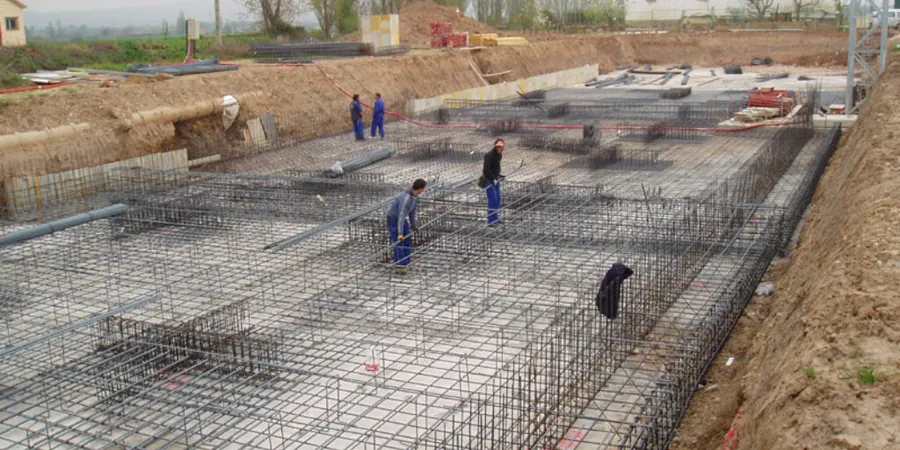
For soft or variable ground in Balbriggan's infill sites, a raft slab often outperforms deep strip footings. We deliver the modulus of subgrade reaction and settlement profile needed to size the raft reinforcement, and we check the sulfate and groundwater conditions that dictate the concrete specification and waterproofing strategy.
Frequently asked questions
How deep do strip footings need to be in Balbriggan?
Depth is dictated by the soil profile, not by a fixed number. On lodgement till, 0.6–0.9 m below ground level is often enough to reach competent bearing stratum. In areas with shrinkable clay or made ground, we typically specify 0.9–1.2 m to get below the zone of seasonal moisture change. The exact depth comes from the trial pit log and the structural engineer's loading.
What does a shallow foundation design report cost in Balbriggan?
For a typical single-house plot in Balbriggan, expect a range of €1,910 to €3,080 depending on the number of trial pits or boreholes required and whether laboratory testing is needed for sulfate or plasticity classification. A commercial extension with deeper investigation will sit at the upper end of that range.
Can you use the neighbour's ground investigation for a new build?
Rarely. Balbriggan's geology is too variable. Even two plots on the same street can have different bearing strata — one on till, the other on filled ground. A site-specific investigation is required under Eurocode 7 to define the ground model for your exact footprint.
Do you test for pyrite in the fill material?
Yes. Where made ground is encountered, we take samples for total sulfur and sulfate testing in an INAB-accredited laboratory. If pyrite is present above the threshold, the foundation concrete specification and granular fill below the slab must be upgraded to mitigate expansion risk.