A mid-rise residential development along the Balbriggan inner relief road required precise groundwater inflow estimates before the excavation of a two-level basement. The site investigation had identified interbedded glacial tills overlying fissured shale of the Balbriggan Formation, a combination that makes desk-based permeability assumptions unreliable. The engineering team specified a series of in-situ Lefranc tests within the overburden and Lugeon packer tests in the underlying bedrock to quantify the hydraulic conductivity profile. In coastal towns like Balbriggan, perched water tables within the till and secondary fracture flow through the shale can produce seepage patterns that standard laboratory tests on small specimens simply cannot capture. The results from these field methods fed directly into the dewatering design and allowed the contractor to size the sump and pump system with confidence, avoiding costly overdesign or dangerous underestimation.
A single Lugeon profile through the Balbriggan shale can reveal more about fracture connectivity than a hundred laboratory permeability tests on intact core.
Methodology applied in Balbriggan
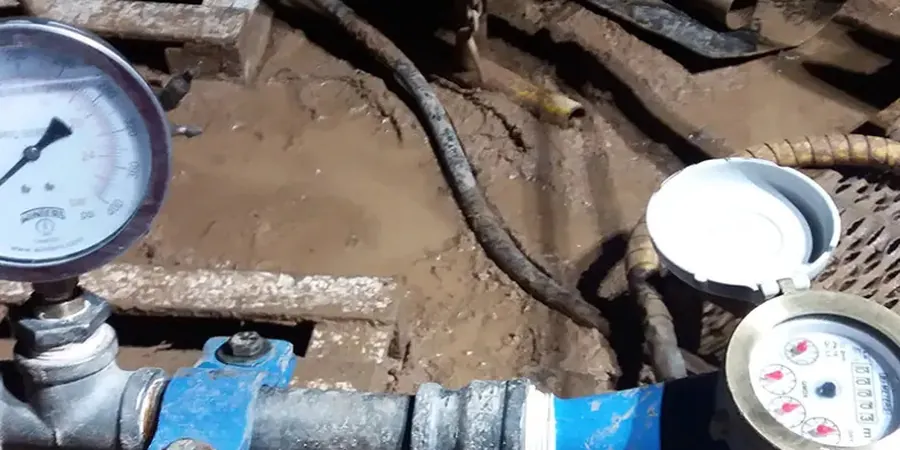
Risks and considerations in Balbriggan
BS 5930:2015+A1:2020 and BS EN ISO 22282-2:2012 are the governing standards for water permeability testing in Ireland, and their requirements carry particular weight in Balbriggan due to the interaction between groundwater and the coastal aquifer. The Balbriggan Inlier's fractured bedrock can transmit tidal signals several hundred metres inland, meaning that hydraulic conductivity is not a static parameter but varies with the tidal cycle. A Lugeon test performed without monitoring the harbour tide level may overestimate or underestimate the sustainable yield of a dewatering system. The Irish EPA requires groundwater abstraction and discharge licensing for any dewatering exceeding 100 m³/day, and inaccurate permeability data can lead to permit refusal or enforcement action. Additionally, the dense till cap over much of the town creates semi-confined conditions: excavation base heave and piping are real hazards if the piezometric surface in the underlying rock is not properly characterized. The Lefranc test in the till provides the entry and exit gradient data necessary for base stability checks under Eurocode 7.
Our services
The field permeability testing program in Balbriggan is executed by experienced drillers and geotechnical engineers using equipment calibrated to ISO 17025 standards. Each test is supervised by a chartered geologist or engineer who logs the borehole advance, selects test intervals based on core recovery and fracture indices, and interprets the data against the local hydrogeological framework of the Balbriggan Inlier.
Lefranc Constant-Head Permeability Test
Designed for soil and weathered rock horizons. A pocket is isolated below the casing, and water is injected at a constant head while measuring steady-state flow. Applied in Balbriggan glacial tills to determine horizontal permeability for retaining wall drainage design and excavation dewatering plans.
Lugeon Packer Test in Bedrock
The standard method for assessing fracture-controlled permeability in the Balbriggan Formation greywacke and shale. Single or double packer configurations isolate 3–5 m intervals in NQ coreholes. Five-stage pressure testing identifies laminar flow, turbulent flow, dilation, and washing-out behaviour per Houlsby interpretation.
Combined Hydrogeological Profiling
A package integrating Lefranc and Lugeon results with piezometer installation and rising-head slug tests. Provides the full vertical conductivity profile required for groundwater impact assessments submitted to Fingal County Council as part of planning applications for large-scale developments in Balbriggan.
Frequently asked questions
What is the difference between a Lefranc test and a Lugeon test?
The Lefranc test measures permeability in soil or heavily weathered rock using a short uncased pocket in a borehole, applying either a constant or falling head. It is suited to the glacial tills and residual soils common across Balbriggan. The Lugeon test is a packer-isolated injection test in competent but fractured bedrock, using five pressure stages to characterize fracture flow behaviour. In practice, a single borehole in Balbriggan will often have Lefranc tests in the overburden and Lugeon tests in the underlying Balbriggan Formation metasediments.
How many Lugeon tests are needed for a basement dewatering design in Balbriggan?
The number depends on site footprint and geological variability, but a minimum of one borehole with tests at three to four depth intervals across the proposed excavation depth is typical for a single residential block. For larger commercial developments near Balbriggan harbour, two or three boreholes are recommended to capture lateral variation in fracture connectivity, particularly where the Bracken River alluvium or marine sediments influence the hydrogeological regime.
What does field permeability testing cost in the Balbriggan area?
For a combined Lefranc and Lugeon testing programme in Balbriggan, budgets typically range from €570 to €880 per test interval, with the final figure depending on borehole depth, access constraints, the number of pressure stages required, and the duration of constant-head monitoring needed to reach steady-state flow conditions in low-permeability till. More info.