In-situ testing in Balbriggan provides direct geotechnical data essential for verifying ground conditions across the town’s mixed glacial till and coastal alluvium. These investigations are carried out in compliance with IS EN 1997-2 and the National Annex for Eurocode 7, ensuring site characterisation meets Irish building regulation requirements. Common methods include dynamic probing and plate load tests, but accurate compaction control on granular fill often relies on a field density test (sand cone method) to confirm compliance with Specification for Road Works Series 600.
Residential foundations, road upgrades, and commercial builds in Balbriggan all require in-situ verification to manage risks from soft clays and variable bearing strata. Shallow foundation inspections are frequently paired with sand cone density testing, while deeper assessments benefit from complementary trial pitting to visually log soil profiles and sample materials at depth. These combined techniques deliver the reliable, regulation-compliant data structural engineers need for safe design.
An active anchor pre-stresses the ground before excavation begins; a passive anchor mobilises resistance only after deformation—choosing the wrong mechanism in Balbriggan's till can translate to centimetres of wall deflection.
Methodology applied in Balbriggan
Risks and considerations in Balbriggan
The anchor performance profile differs markedly between Balbriggan’s two principal ground types. On the northern side along the Barnageeragh Road, where the till is dense and well-drained, passive anchors can achieve sufficient bond at relatively shallow depths with minimal creep under sustained load. Conversely, the harbour corridor and the area east of the railway line toward Bremore show interbedded soft marine silts and saturated sand horizons that can bleed grout during installation, drastically reducing the effective bond perimeter unless pressure-controlled grouting is applied during primary injection. The greater risk in Balbriggan lies with active anchors installed through these softer layers: if the fixed anchor is grouted within a permeable lens, the pre-stress force can migrate into the tendon free length through incomplete debonding, producing a catastrophic loss of lock-off load within the first 48 hours—something we have diagnosed on remedial projects where earlier anchor designs treated the entire soil column as homogeneous till.
Our services
Anchor systems we design and supervise for construction projects across Balbriggan and the wider Fingal area:
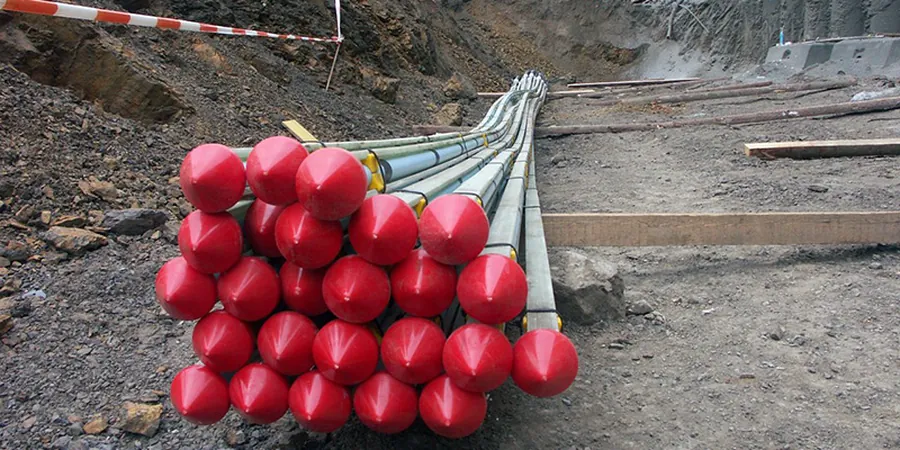
Active pre-stressed strand anchors
Permanent or temporary anchors with 15.7 mm strands, double corrosion protection, and post-tensioning to specified lock-off loads for retaining walls and basement slabs subject to high lateral earth pressures.
Passive self-drilling hollow bar anchors
Continuous threadbar systems drilled and grouted in one pass, ideal for temporary excavations in Balbriggan’s constrained urban plots where access for pre-stressing equipment is limited and deformation tolerance exists.
Anchor acceptance and suitability testing
72-hour creep tests, cyclic loading protocols, and lift-off checks conducted on sacrificial anchors to validate bond parameters in Balbriggan’s lodgement till before production drilling begins.
Corrosion risk assessment and protection design
Site-specific evaluation of soil resistivity, chloride content, and groundwater chemistry for anchors exposed to Balbriggan’s coastal environment, with protection class selection per BS 8081.
Frequently asked questions
What is the difference between an active and a passive ground anchor?
An active anchor is tensioned against the retaining structure immediately after installation, applying a pre-stress force that limits ground movement from the start. A passive anchor is not pre-stressed; it develops its resisting force only when the retained soil mass begins to deform and transfer load into the fixed length. In Balbriggan’s dense lodgement till, active anchors are preferred for permanent walls where deflection control is strict, while passive hollow bars often suit temporary basement excavations where a few millimetres of movement can be tolerated.
How deep do ground anchors need to go in Balbriggan’s soils?
The bonded length typically sits 4 to 8 metres into the unweathered grey till, with the free length extending another 5 to 15 metres behind the theoretical failure plane. The critical factor here is that the upper weathered crust—often 2 to 3 metres thick across Fingal—delivers much lower grout-to-ground bond, so the fixed anchor zone must start below that oxidized layer to meet the design working load without excessive creep.
What anchor testing is required in Ireland?
Irish practice follows BS 8081 and I.S. EN 1537, with acceptance testing to DIN EN ISO 22477-5. For permanent anchors in Balbriggan, we perform a 72-hour creep test at the maximum proof load, plus cyclic loading sequences on a sacrificial trial anchor to confirm the bond parameters used in the design. Every production anchor is then proof-tested to 1.5 times the working load before the lock-off load is applied.
What does anchor design and installation cost in North County Dublin?
For active or passive anchor systems in Balbriggan and the surrounding Fingal area, the design, testing, and supervision package typically falls between €1,080 and €2,930 per anchor, depending on whether it is temporary or permanent, the required corrosion protection class, and the number of sacrificial test anchors needed to validate the bond in the specific till profile on site. More info.