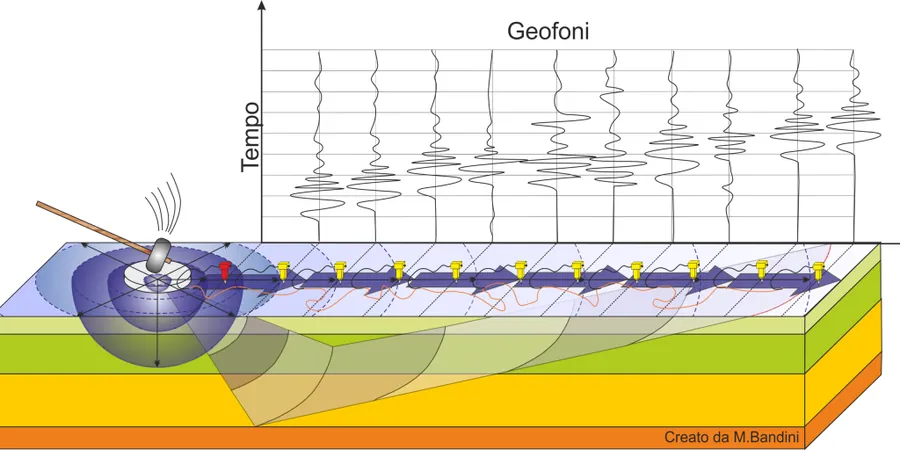
Balbriggan sits on a mix of glacial tills and alluvial deposits where the shallow bedrock can vary from less than two metres to over ten metres deep, depending on how close you are to the Bracken River or the coast. This variation makes the shear wave velocity profile anything but uniform. A proper MASW survey maps the stiffness of these layers without disturbing the ground, which is critical when the water table sits barely a metre below the surface near Quay Street. Subcontracting teams run twenty-four-channel spreads along building footprints and roadway alignments, combining active shots with passive recordings to reach the thirty-metre depth required for a reliable VS30 calculation. The result is a site class determination that holds up under the Eurocode 8 framework, giving the design engineer a measured stiffness instead of a conservative guess pulled from a lookup table.
A measured VS30 in Balbriggan often moves the site class up one bracket, directly reducing the seismic design forces in the structural model.
Methodology applied in Balbriggan
Risks and considerations in Balbriggan
The coastal humidity in Balbriggan is not just a nuisance for construction sequencing — it saturates the uppermost two metres of glacial till for much of the winter, softening the very layer that controls the top portion of the shear wave velocity profile. A MASW line run in February can return a VS30 a good fifteen to twenty percent lower than the same line run in August, purely because of seasonal moisture. The technical team accounts for this by scheduling measurements either at the driest feasible window or by pairing the survey with a test pit to log the actual moisture condition at the time of acquisition. Ignoring the seasonal swing risks locking in a site class that is both conservative and unnecessary, adding steel and concrete to a foundation that the ground did not actually require.
Our services
MASW surveys in Balbriggan are delivered as a modular package — choose the depth and resolution that matches the project stage, from preliminary site class screening to detailed 2D stiffness cross-sections.
VS30 Site Class Determination
Single-line MASW survey processed to a 1D shear wave velocity profile down to thirty metres. Delivers the Eurocode 8 site class and the VS30 value for structural design input. Suitable for residential extensions, commercial units, and school buildings where the design team needs a measured classification to replace the default ground type.
2D Shear Wave Velocity Cross-Section
Multiple parallel MASW lines or a rolling spread along a linear alignment, processed into a continuous 2D stiffness section. Used for pipeline routes, embankment foundations, and cut-and-cover excavations where lateral variability in the glacial till governs differential settlement predictions.
Frequently asked questions
Does a MASW survey in Balbriggan replace a borehole investigation?
It complements it, but does not replace it. MASW provides a continuous stiffness profile and the VS30 value for seismic design, while a borehole gives you the actual soil description, SPT blow counts, and samples for laboratory testing. Most projects in the Fingal area run both: the borehole for the factual ground model and the MASW line for the dynamic stiffness parameters that feed into the structural analysis.
How much does a MASW / VS30 survey cost in Balbriggan?
A single-line MASW survey with VS30 determination in the Balbriggan area typically falls between €1,430 and €2,670, depending on the array length, whether passive recording is included, and how accessible the site is for the geophone spread. A formal quote is provided once the site dimensions and project requirements are confirmed.
How deep does the MASW method reach in Balbriggan soils?
With an active source — a sledgehammer or weight drop on a 24-channel spread — the method reliably resolves the top fifteen to twenty metres. Adding a passive recording window of twenty to thirty minutes, where the array captures ambient noise, typically extends the investigation depth to thirty metres or more, which is sufficient for the VS30 calculation required by Eurocode 8.
Which site class does Balbriggan typically fall into?
There is no single answer, because the glacial till and alluvial deposits vary significantly across the town. Without site-specific data, engineers often assume Class C or D. Where MASW has been run, measured VS30 values frequently place sites in Class B or C, which reduces the seismic coefficient used in the design and can lead to more economical foundations.