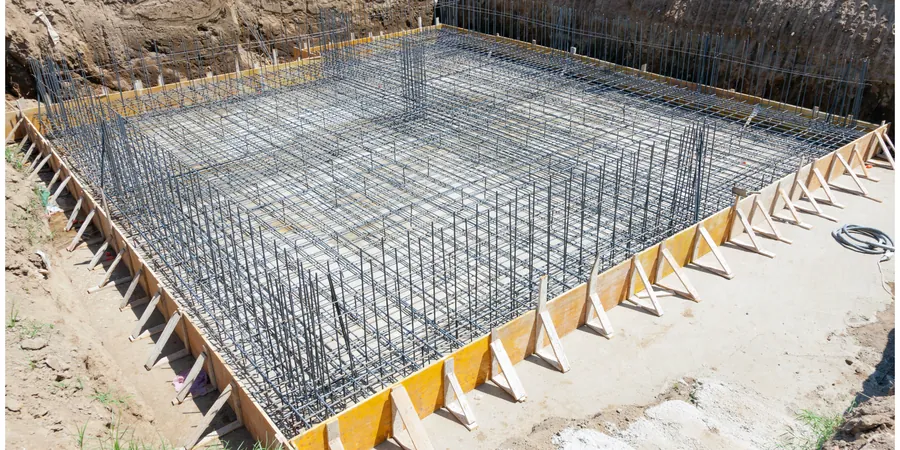
In Balbriggan, many builders know the feeling: you excavate a metre down and find soft silty clay that doesn't stop. The Bracken River floodplain and coastal deposits create a substrate that challenges conventional footings. Raft foundation design becomes the practical answer. A rigid slab spreads the building load across a wide area. This avoids the differential settlement that cracks walls in the town's newer estates. Our team produces raft designs that factor in Balbriggan's high water table, which sits just 1.5 to 2.0 metres below ground level in many sites near the harbour. Before finalising a raft, we often pair the design with in-situ permeability testing to confirm drainage assumptions under the slab.
A properly designed raft in Balbriggan reduces differential settlement to under 10 mm, protecting the superstructure from the town's variable glacial soils.
Methodology applied in Balbriggan
Risks and considerations in Balbriggan
A mobile drilling rig arrives on site to extract undisturbed samples from the zone of influence. The rig's rotary core barrel cuts through Balbriggan's stiff upper crust to reach the softer layers below. Without this physical verification, a raft design rests on assumptions. The primary risk in this part of north County Dublin is differential settlement caused by lens-shaped pockets of soft silt within the till. A raft that is too thin or under-reinforced will crack at the points where the ground transitions from stiff to soft. Secondary risk comes from sulphate attack on the concrete. The underlying shale can release sulphates into the groundwater. Our mix design specifies sulphate-resisting cement where total potential sulphate exceeds 2.5% by mass of soil, as identified during chemical testing of the borehole samples.
Our services
Our raft foundation service in Balbriggan covers the full engineering scope, from ground investigation through to reinforcement detailing and construction oversight.
Geotechnical Site Investigation
Boreholes and trial pits across the Balbriggan site to map the glacial till, measure the water table, and recover samples for laboratory classification and strength testing.
Structural Raft Design
Finite element modelling of the soil-raft interaction, producing bending moment envelopes, shear checks, and a full reinforcement schedule compliant with Eurocode 2.
Construction Phase Support
On-site inspections during blinding, rebar placement, and concrete pouring. We verify cover depth, compaction of the sub-base, and the integrity of any ground improvement beneath the raft.
Frequently asked questions
How much does a raft foundation design cost for a house in Balbriggan?
For a single residential dwelling in Balbriggan, the design fee typically falls between €860 and €1,600, depending on the complexity of the ground conditions and the number of boreholes required. A larger commercial raft design, involving more extensive site investigation and multiple load cases, ranges from €2,200 to €4,140.
Is a raft foundation better than strip footings in Balbriggan?
On the soft alluvial clays found near the Bracken River and coastal parts of Balbriggan, a raft is often more reliable than strip footings. It spreads the load over a larger area, which reduces the risk of differential settlement. Strip footings work well on the stiffer boulder clay to the north, but the raft provides a more uniform solution where the ground changes across the site.
How long does the design process take?
The site investigation and reporting phase takes about two weeks. Structural design and reinforcement detailing normally require another two weeks. A complete package, from first site visit to issuing construction drawings, is typically delivered within four to five weeks for a standard residential project in Balbriggan.