Balbriggan's growth from a small fishing village into a thriving commuter town has placed increasing demands on its underground infrastructure, pushing new sewer and utility tunnels into the complex glacial deposits that underlie the town. The legacy of the last ice age left behind a varied sequence of lodgement tills, glaciofluvial sands and soft estuarine silts along the Bracken River valley—materials that behave very differently once you start excavating below the water table. Understanding how these deposits will react to tunnelling is not a matter of applying generic assumptions; it requires focused geotechnical analysis for soft soil tunnels that accounts for the local stratigraphy, groundwater regime and the low effective stress conditions typical of coastal north County Dublin. The interaction between tunnel face stability and the soft, compressible layers found across Balbriggan demands a careful programme of laboratory testing and site investigation, something our team has refined through years of working on projects across Fingal. When you are advancing a tunnel through silty clays with undrained shear strengths below 40 kPa, the margin for error shrinks significantly—and that is where our laboratory's role becomes critical, providing the soil parameters that feed directly into the finite element models and settlement predictions required by the local authority. For projects involving open-face excavation methods in these sensitive materials, the characterisation work often runs in parallel with in-situ permeability testing to determine how quickly groundwater will migrate toward the excavation face, a parameter that directly influences the choice of temporary support and dewatering strategy.
In Balbriggan's coastal tills, the transition from drained to undrained behaviour during tunnelling depends on just a few metres of cover—and getting that boundary right is what prevents surface settlement incidents.
Methodology applied in Balbriggan
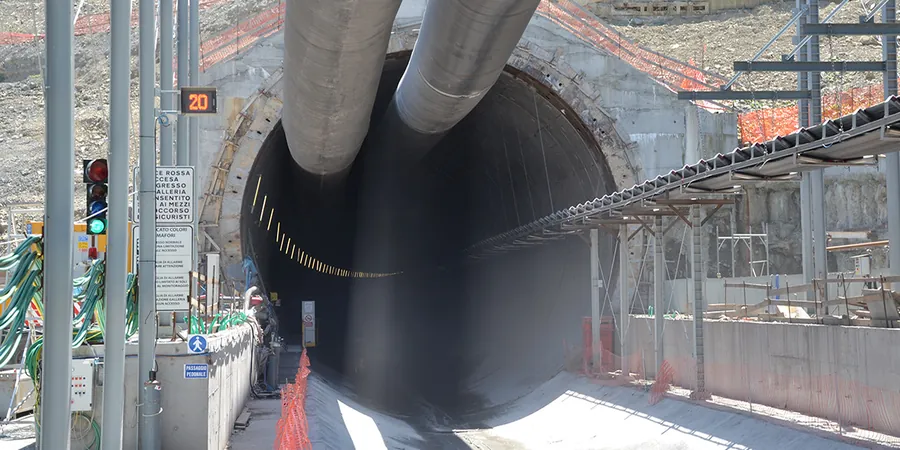
Risks and considerations in Balbriggan
The geological mapping of the Balbriggan area, published by the Geological Survey of Ireland, shows a dominance of Late Devensian tills overlying Carboniferous shale and greywacke bedrock, but the critical detail for tunnelling is the presence of buried channels filled with soft alluvium along the Bracken River corridor. These channels can drop the bedrock surface by 15 to 20 metres below the surrounding till plain, creating abrupt transitions in ground conditions over distances of less than 50 metres—exactly the kind of scenario that generates differential settlement at the surface and concentrated loads on the tunnel lining. A geotechnical analysis for soft soil tunnels that does not identify these buried channels through adequate ground investigation risks encountering collapse conditions at the transition zone, where the tunnel passes from stiff till into normally consolidated organic silt with substantially lower face stability. The groundwater table in Balbriggan sits high, typically within 1.5 to 2.5 metres of ground level during winter months, which means that even shallow tunnels are operating below the phreatic surface and require continuous assessment of effective stress conditions. We have seen projects where a single unanticipated sand lens, pressurised by the regional groundwater gradient toward the sea, introduced face inflows that required emergency grouting and set the programme back by weeks. The lesson is consistent: the cost of adequate laboratory testing and ground characterisation before construction is negligible compared to the cost of recovering from a face collapse in a residential area.
Our services
Our laboratory support for soft ground tunnelling projects in Balbriggan is built around the specific testing requirements that emerge from the ground conditions and the chosen construction method. Each service listed below contributes a piece of the geotechnical model that the tunnel designer needs.
Advanced Triaxial Testing with Pore Pressure Measurement
Consolidated-undrained and drained triaxial tests on undisturbed till and silt specimens to determine effective stress strength parameters (c' and φ'), critical state behaviour and stress path response. We use local strain instrumentation for small-strain stiffness measurement, essential for TBM settlement predictions in Balbriggan's residential zones.
One-Dimensional Consolidation and Swell Testing
Oedometer tests to establish compression index, swelling index and preconsolidation pressure of the soft estuarine clays found along the Bracken River valley. These parameters feed directly into the prediction of long-term surface settlement above the tunnel crown and the evaluation of heave at the invert.
Permeability and Groundwater Chemistry Analysis
Falling-head and constant-head permeability tests on undisturbed samples, combined with water chemistry profiling to identify saline intrusion zones. This data supports dewatering design and the assessment of grout durability in the aggressive groundwater environment near the Irish Sea coast.
Classification and Index Testing Suite
Full geotechnical classification including particle size distribution by sieving and sedimentation, Atterberg limits, moisture content, density and organic content determination—all performed under our ISO 17025 accredited procedures to provide the baseline data for tunnel face stability analysis and soil conditioning specifications.
Frequently asked questions
What is the typical cost range for a geotechnical analysis for soft soil tunnels in Balbriggan?
For a tunnel project in Balbriggan, the laboratory testing programme typically falls between €3,470 and €13,410, depending on the number of boreholes, the sampling density and the specific test methods required. A basic programme for a short utility tunnel might include classification tests and a limited number of triaxial tests at the lower end of the range, while a full investigation for a TBM-driven sewer tunnel with consolidation testing, permeability measurements and multistage triaxial work across multiple stratigraphic units will approach the upper end. We provide a detailed quotation based on the ground investigation scope and the construction method proposed.
How do you obtain undisturbed samples in Balbriggan's soft tills for tunnel design?
Undisturbed sampling in the lodgement tills and soft silts of Balbriggan is done using thin-walled Shelby tubes pushed hydraulically from boreholes advanced with hollow-stem augers or rotary drilling with casing support. The key is to maintain a consistent push rate and to minimise vibration during sampling, because the sensitive fabric of the estuarine silts can be easily disturbed. Samples are immediately sealed with wax and transported to our laboratory in temperature-controlled conditions for extrusion and specimen preparation within 24 hours, preserving the in-situ moisture content and soil structure that are critical for obtaining reliable strength and stiffness parameters.
What laboratory tests are most critical for assessing face stability in soft ground tunnelling?
For face stability analysis in Balbriggan's soft soils, the most critical laboratory tests are consolidated-undrained triaxial tests with pore pressure measurement to determine undrained shear strength and effective stress parameters, combined with oedometer tests to establish the consolidation state of the material. We also recommend particle size distribution analysis to identify any granular layers that could lead to face ravelling, and Atterberg limits to assess the plasticity characteristics that influence both short-term stability and the potential for clogging on the TBM cutterhead. When the tunnel alignment passes through the Bracken River alluvium, permeability testing becomes equally important for evaluating groundwater inflow risk.