The ground beneath Balbriggan tells two very different stories. Along the coastal stretch near the harbour, thick sequences of loose marine sands and soft estuarine silts dominate the subsurface, remnants of a post-glacial coastline that still shapes how structures behave. Move just half a kilometre inland toward the Naul Road and you encounter denser glacial tills that offer far better bearing but can mask deeper loose layers. This split personality of Balbriggan's geology means that a one-size-fits-all foundation approach rarely works. When the site investigation flags loose granular soils below the water table, vibrocompaction design becomes the logical path to avoid costly over-excavation or deep piling. Our work across north County Dublin has shown repeatedly that a well-calibrated vibrocompaction grid, specified to the relative density targets that Eurocode 7 demands, transforms these challenging Balbriggan sands into a competent bearing stratum without importing a single tonne of stone.
Achieving 70% relative density in loose estuarine sands is not about horsepower; it is about matching frequency, spacing, and dwell time to the grain-size curve of the specific deposit.
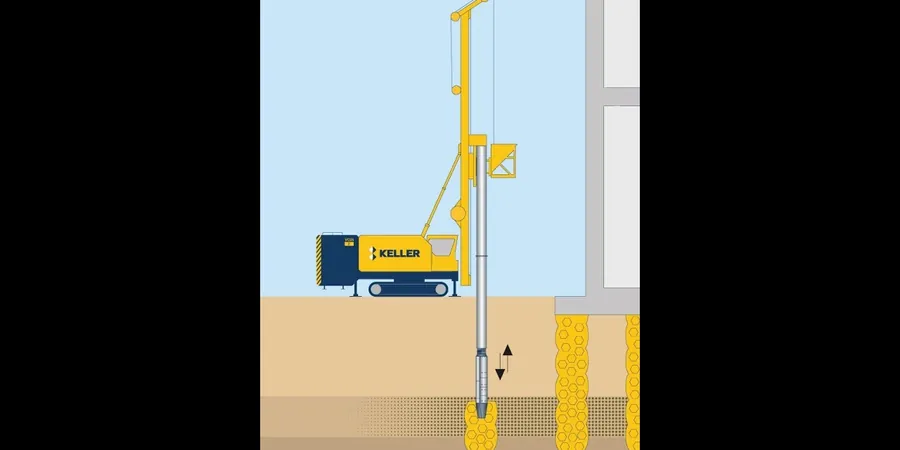
Methodology applied in Balbriggan
Risks and considerations in Balbriggan
Eurocode 7, applied through the Irish National Annex, requires that ground improvement by vibrocompaction be treated as a design-and-verify process, not a prescriptive recipe. In Balbriggan this requirement bites hard because the loose sands along the Delvin River valley and the coastal margin are often interlaced with thin silt partings that can choke pore-pressure dissipation during vibration. If the designer ignores those partings, the vibroflot energy goes into liquefying a trapped water lens rather than densifying the sand skeleton, and the post-treatment CPT shows a beautiful refusal curve that collapses three weeks later when excess pore pressures finally bleed away. We have seen this on two sites near Bremore where the initial verification looked perfect but the follow-up check at 28 days told a different story. A rigorous vibrocompaction design for Balbriggan must therefore include staged pore-pressure monitoring and a mandatory late-age verification test, particularly where the groundwater has a tidal connection less than 400 m away.
Our services
Every vibrocompaction project in Balbriggan starts with a clear picture of what is down there and ends with proof that the ground now meets the design intent. The two service packages below cover the full lifecycle from investigation through to verification.
Pre-treatment investigation and vibro design
We combine borehole logging, grain-size analysis, and in-situ density measurements to build a ground model specific to your Balbriggan site. The vibrocompaction grid, probe type, frequency range, and dwell time are then designed to achieve the target relative density, with settlement estimates produced for the treated ground under the proposed foundation loads.
Post-treatment verification and as-built reporting
Using CPT, SPT, or zone load testing as dictated by the ground conditions and the structure's risk category, we confirm that the vibrocompaction has delivered the specified improvement. All data is compiled into an as-built report suitable for submission to the building control authority and the design team's checking engineer.
Frequently asked questions
What soil types in Balbriggan are suitable for vibrocompaction?
The method works best on loose sands and gravelly sands with a fines content below 12-15%. Much of Balbriggan's coastal and river-valley strip falls into this category, particularly the sands encountered between 2 m and 8 m depth. Silty sands can be treated but require closer spacing and careful frequency control. Pure silts and clays are not suitable; for those materials we would typically recommend stone columns or rigid inclusions instead.
How much does a vibrocompaction design and treatment programme cost in Balbriggan?
The combined cost of investigation, vibrocompaction design, treatment execution, and verification testing in the Balbriggan area typically falls between €1,140 and €4,540, depending on the footprint area, treatment depth, grid spacing, and the number of verification tests required. A small residential plot with shallow treatment will sit at the lower end; a multi-storey commercial building requiring treatment to 8 m or more pushes toward the upper range.
How long does the treatment take, and what about noise and vibration?
A typical Balbriggan residential or light-commercial site can be treated in 2 to 5 working days, including mobilisation and verification testing. The vibroflot generates ground-borne vibration that is perceptible up to about 30-40 m away, so we carry out pre-condition surveys on adjacent structures and schedule work during agreed hours. For sensitive buildings within 15 m, we often switch to a variable-frequency profile that avoids resonant frequencies of the neighbouring structures. More info.