We often see pavement failures in Balbriggan that trace back to one simple oversight: assuming the subgrade strength without a proper laboratory soak test. The marine clay pockets scattered across this coastal stretch near the M1 behave differently when saturated, and a field guess won't cut it. Our laboratory CBR test gives you the soaked strength value that TII pavement design methods actually require. Balbriggan's mix of glacial till and alluvial silts means the CBR can swing from 2% to over 15% in the same site—skip the lab and your pavement thickness will be wrong from day one. We run the test under controlled moisture and density conditions so the number you get isn't just a figure, it is a defensible design input.
A soaked CBR of 2% versus 5% can change your pavement thickness by over 100 millimetres. In Balbriggan, that difference shows up within the first two winters.
Methodology applied in Balbriggan
Risks and considerations in Balbriggan
One thing we notice repeatedly in Balbriggan is that site investigation reports quote unsoaked CBR values and call it a day. That works in arid climates; it does not work 800 metres from the Irish Sea. A silty clay that gives you 12% CBR at natural moisture can drop below 2% after four days of soaking, and Balbriggan's winter water table sits high enough to keep the subgrade wet for months. If your pavement design uses the unsoaked number, you are underdesigning by a wide margin. The other risk is ignoring swell—some of the estuarine clays south of the harbour show 4-5% volume increase on soaking, and that heave will telegraph right through a thin pavement structure within the first year of service.
Our services
Our Balbriggan laboratory handles the full sequence from sample preparation to data interpretation, aligned with current Irish road standards.
Standard CBR for TII Pavement Design
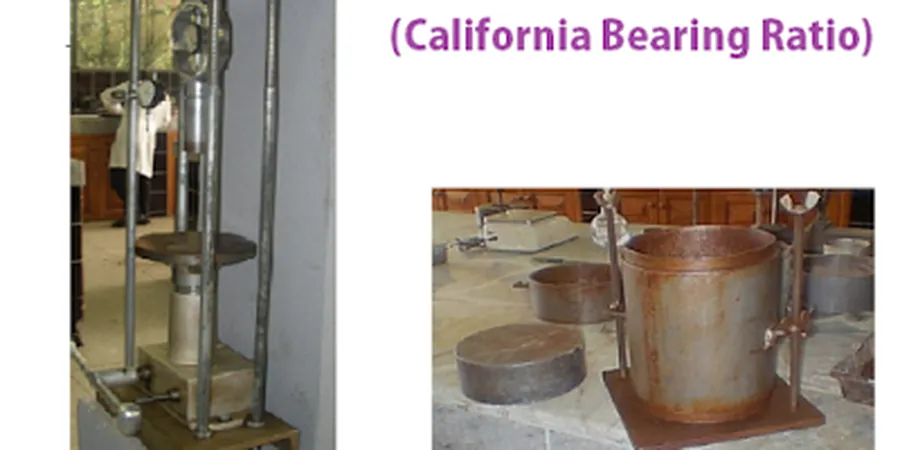
Three-point compaction and 96-hour soak following BS 1377-4:1990, providing the soaked CBR at 2.5 mm and 5.0 mm penetration. We report the swell percentage and moisture condition value alongside the CBR, because both matter for Balbriggan's moisture-sensitive subgrades.
CBR on Stabilised Materials
When lime or cement treatment is proposed for weak silts in north Balbriggan, we test the stabilised mix at 7 and 28 days. The unsoaked CBR after curing tells you if the treatment actually achieved the target strength before you pave.
Frequently asked questions
What does a laboratory CBR test cost in Balbriggan?
A standard three-point soaked CBR test in our Balbriggan lab typically runs between €120 and €190 per specimen, depending on whether we are testing natural subgrade or a stabilised mix. A full set of three specimens needed for the compaction curve brings the total to roughly €360 to €570. We always recommend testing at least two bulk samples from different locations on site.
Why soak the sample for 96 hours?
The 96-hour soak under surcharge simulates the worst-case moisture condition the subgrade will see during the pavement's design life. In Balbriggan, where winter groundwater can rise to within 500 mm of formation level, the soaked CBR is the only value that represents long-term performance. BS 1377-4 specifies this duration precisely because shorter soaks consistently overestimate strength in temperate maritime climates.
Can you test stabilised material with cement or lime?
Yes, we test cement- and lime-stabilised materials after the specified curing period, typically 7 or 28 days. For TII schemes in the Balbriggan area, we often run both unsoaked CBR after curing and a short soak to check moisture susceptibility. The preparation and compaction follow the same BS 1377-4 framework, adjusted for the binder content and mellowing period.
How many samples do I need for a pavement design in Balbriggan?
TII guidance and our own experience in Balbriggan suggest a minimum of one bulk sample per distinct soil unit encountered, with two or three better where the geology varies over short distances. Because the till and alluvial deposits around Balbriggan can change within 50 metres, we recommend sampling every trial pit that hits a different material. Each sample then needs three compaction points for a full CBR curve. More info.