The most expensive mistake we see in Balbriggan is importing a clean granular fill that turns into soup after the first heavy rain, simply because nobody ran a full grading curve with the fines fraction. Contractors assume a borrow pit material drains freely until a Proctor test reveals the moisture-density relationship is completely off, and then the compaction targets become impossible to hit. The underlying problem is almost always the silt and clay content that a standard sieve analysis misses entirely. Our laboratory runs the combined ASTM D422 method—sieves for the coarse fraction and a hydrometer for material passing the No. 200 sieve—so the full particle size distribution is on the table before a single load of stone arrives on site. In a coastal town like Balbriggan, where the subgrade alternates between boulder clay and estuarine silts within a few hundred metres, that level of resolution is the difference between a pavement that lasts and one that heaves in its first winter.
A single grain size curve can red-flag a frost-susceptible silt before it gets compacted under a foundation—saving months of remedial work.
Methodology applied in Balbriggan
Demonstration video
Risks and considerations in Balbriggan
The drift geology around Balbriggan—dominantly Late Devensian till overlying Carboniferous shale and limestone—produces a till matrix that is dense, overconsolidated, and deceptively well-graded in the hand specimen. When you run a hydrometer on the fines, however, it regularly shows a clay fraction exceeding fifteen percent, and that clay mineralogy is predominantly illite with a moderate shrink-swell potential. If the grain size curve is truncated at the No. 200 sieve and the clay fraction is ignored, the pavement design assumes a free-draining subgrade that does not exist. The consequence is differential frost heave along the R132 corridor or excessive pore pressure buildup under the floor slabs of the new residential schemes east of the railway line. We have also encountered lenses of glaciofluvial sand within the till that appear clean but contain enough silt-sized carbonate flour to trigger collapse settlement when saturated. A complete particle size distribution—coarse, intermediate, and colloidal—allows the drainage and consolidation behaviour to be predicted before the excavator bucket breaks ground.
Our services
Our Balbriggan laboratory provides two tiers of grain size analysis depending on the project specification and the material type encountered. Both tiers are backed by the same ISO 17025-accredited quality system and include a signed report with the full grading curve plotted on a standard semi-logarithmic chart.
Full Combined Analysis (Sieve + Hydrometer)
Covers the complete range from coarse gravel down to the colloidal clay fraction. Required for earthworks classification per the Irish Specification for Road Works (SRW) and for assessing frost susceptibility, internal erosion potential, and filter compatibility. We wash the sample over the 63 µm sieve, dry and sieve the retained fraction, and run a sedimentation test on the passing fraction with temperature-controlled hydrometer readings over 24 hours.
Rapid Wash-Sieve Analysis
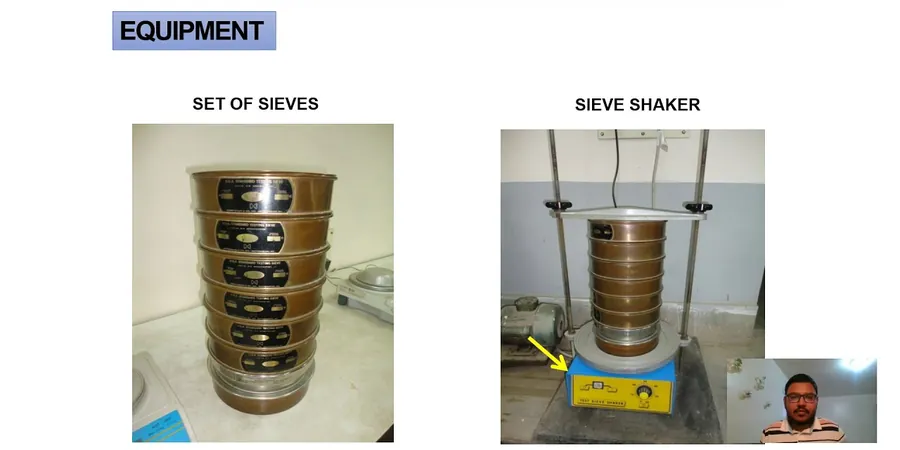
A faster option for clean granular materials where the fines content is expected to be below five percent. We dry the sample, wash it through the No. 200 sieve to quantify the minus 75 µm fraction, and sieve the retained material through a full stack from 37.5 mm down to 75 µm. Turnaround is typically two working days, and the report includes the Cu and Cc coefficients for filter design and drainage assessments.
Frequently asked questions
How much does a grain size analysis cost for a project in Balbriggan?
A standard combined sieve and hydrometer analysis typically runs between €90 and €190 per sample, depending on whether the material is predominantly granular or fine-grained and how many splits are required. We provide a fixed-price quote once we know the number of samples and the expected soil type.
What is the difference between a sieve analysis and a hydrometer test?
A sieve analysis measures the distribution of particles larger than 75 microns (retained on the No. 200 sieve) by passing the material through a stack of progressively finer sieves. The hydrometer test measures the distribution of silt and clay particles smaller than 75 microns by observing the sedimentation rate in a water column. A complete grain size curve requires both methods to cover the full range from gravel down to the colloidal clay fraction.
How much soil do you need for a combined sieve and hydrometer test?
We ask for at least 500 grams of dry material for sandy soils and around 200 grams for silts and clays. The sample must be representative of the layer in question, so we recommend taking it from a disturbed bulk sample bagged at the excavation face rather than from the auger flights, which can segregate the fines.
How long does it take to get the results back?
A full combined analysis generally takes three to five working days due to the 24-hour sedimentation period required for the hydrometer. A rapid wash-sieve analysis on clean granular material can be turned around in two working days.
Can the grain size curve tell me if the soil is frost-susceptible?
Yes. Materials with more than three percent by mass finer than 20 microns are considered frost-susceptible under Irish pavement design guidelines. The hydrometer portion of the test gives you that exact percentage, which is critical for Balbriggan where winter ground temperatures regularly drop below zero and the till matrix often exceeds the three-percent threshold.